
From Root to Powder
Great kava powder is not an accident. Eight stages sit between a plant in the ground and a bag that meets specification — and each one is a place where quality is either protected or lost.
Two kilograms of kava powder can look identical, come from the same island, carry the same cultivar name, and differ by half in kavalactone content. The difference is almost never the plant. It is what happened to it between the field and the bag.
This page walks through the full processing chain — what each stage does, why it exists, and specifically what goes wrong when it is rushed or skipped. Buyers evaluating suppliers can use it as a set of questions; the failure modes listed here are the ones that produce the batch problems we see reported most often.
Harvest and plant selection
Mature plants are lifted whole after four to five years in the ground.
Kava is a slow crop. A plant needs roughly four to five years before its root mass and kavalactone content justify harvest, and material lifted earlier carries measurably less active content along with a different compound balance.
The whole plant is lifted rather than cut, because the lateral roots — the highest-kavalactone part of the plant — grow outward and downward from the base and are easily left in the soil by a careless harvest.
Cultivar identity is established at this stage, in the field, by farmers who know their own plantings. This is the first and most reliable point of noble verification; everything downstream is confirmation.
Harvesting immature plants during price spikes. It is invisible in the finished powder and shows up only as a low kavalactone assay — which is why the certificate matters more than the appearance.
Separation of plant parts
Lateral roots, basal stump and aerial parts are separated and graded.
The plant is divided into its commercially distinct parts: lateral roots (waka in Fijian usage), the basal stump and rhizome (lewena), and the aerial stems and leaves.
Lateral root carries the highest kavalactone concentration; stump material carries less. Both are legitimate kava, and they are priced differently for that reason.
Aerial parts are excluded entirely. Stems and leaves contain pipermethystine, an alkaloid essentially absent from the root, and their inclusion in export material during the demand surge of the late 1990s is one of the leading explanations for the liver-injury reports that reshaped kava regulation.
Stem peelings and chip material blended in to increase yield. This is the single most consequential adulteration in the category, and it is undetectable by eye once the material is milled.
Washing and peeling
Soil is removed and the outer bark of the rootstock is peeled away.
Root arrives from the field carrying soil, and thorough washing is the primary control on the mineral and microbial load that will show up on the finished certificate.
The outer bark of the rootstock is peeled. Traditional practice in the Pacific has long included peeling, and the practice is reflected in modern standards — the aqueous extracts used in clinical research have generally specified peeled rootstock.
Water quality at this stage is itself a control point. Washing clean root in contaminated water simply relocates the problem.
Inadequate washing raises heavy metal and microbial results downstream. Skipping the peel is faster and increases yield, and moves the material away from the specification the safety evidence is built on.
We double-peel the stump and peel the laterals, discarding every peeling as waste — none of that material re-enters the product. It is not standard practice in the category; we do it as part of our commitment to putting higher-quality kava into the industry. The result is a noticeably cleaner, smoother finished product.
Splitting and sizing
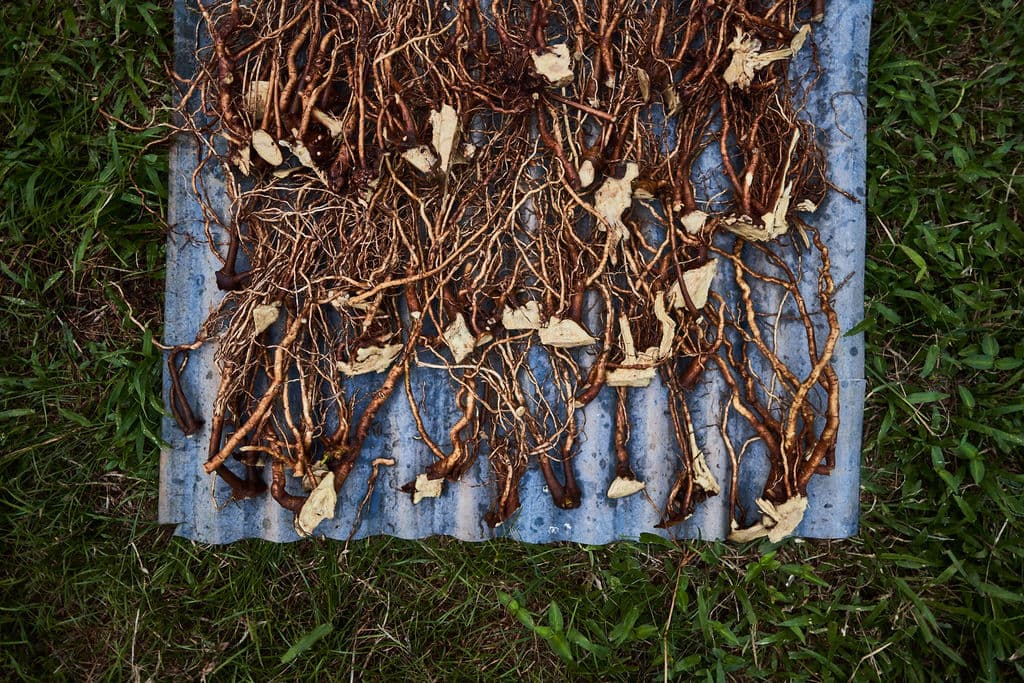
Root is split and chipped to a uniform size so it dries evenly.
Whole roots dry from the outside in. Left intact, the surface dries and hardens while the core remains wet — producing material that reads as dry by weight but carries pockets of moisture that later support mould growth.
Splitting and chipping to a consistent size is what makes even drying possible, and it is a genuine quality differentiator between operations.
Inconsistent chip size producing partially dried cores. This is a common source of microbial failures in material that otherwise looks fine.
Drying
Moisture is reduced to a stable level — removing roughly four-fifths of the material's weight.
Fresh kava root is mostly water. Drying to a stable moisture content removes around 75–80% of its mass, so roughly four to five kilograms of fresh root yield one kilogram of dry material. Every upstream cost is multiplied accordingly.
Sun drying is traditional and inexpensive, but weather-dependent: a rain interruption mid-cycle raises mould and microbial risk sharply. Controlled mechanical drying costs more per kilogram and produces more consistent, lower-risk material with a repeatable moisture endpoint.
Drying is also where kavalactone content can be lost. Kavalactones degrade with heat, so aggressive drying to save time trades assay value for throughput.
Interrupted sun drying, or over-aggressive heat. The first shows up as microbial and mould results; the second as a lower kavalactone assay than the raw material should have delivered.
Milling and sieving
Dried root is ground and sieved to the particle size the end use requires.
Particle size is a functional specification, not a cosmetic one. Traditional grind destined for kneading and straining needs a particle size fine enough to release kavalactones efficiently but coarse enough that it does not pass through a strainer bag into the finished drink.
Instant and water-soluble formats are milled and processed differently again, because the end user is not straining anything.
Milling generates heat. Poorly controlled milling raises material temperature enough to degrade kavalactones, which is why throughput and assay are in tension at this stage as well.
Sieving removes oversize fibre and produces the consistency that lets a kava bar get the same result from the same recipe batch after batch.
Grinding too coarse leaves kavalactones locked in fibre that the customer discards. Grinding too fine sends particulate through the strainer and produces a gritty drink.
Verification and testing
Each batch is assayed for kavalactone profile, contaminants and microbial load.
HPLC profiling reports all six kavalactones individually, which yields both the total content used for dosing and the chemotype used to confirm cultivar identity. Noble cultivars show a dominance pattern beginning 42 or 24.
Contaminant panels cover heavy metals against USP <232> limits, microbial screening, and pesticide residues. Extract formats add residual solvent testing per USP <467>.
Testing is per batch. A single historical certificate reused across lots tells a buyer nothing about the material actually in the bag.
Reporting a total kavalactone figure without the individual six. Without the breakdown there is no chemotype, and without a chemotype there is no evidence of noble identity.
Packing and storage
Material is packed to protect against moisture, heat and light, then held under controlled conditions.
Kavalactones degrade with exposure to heat, light and oxygen. Packaging and storage conditions determine how much of the assayed content survives to the customer.
Moisture ingress after packing undoes the drying stage entirely, so barrier properties and seal integrity matter as much as the container itself.
Batch identifiers applied at packing are what make traceability back to a harvest lot possible — the difference between a recall that targets one lot and one that targets everything.
Long ambient storage in hot conditions. Material can meet specification at packing and assay materially lower months later, which is why manufacture date on the certificate matters.
Eight stages, and a broker controls none of them
Every failure mode above happens before the material is bagged. A supplier who buys finished powder on the open market inherits all of them and can correct none of them — they can only test for the damage after the fact, if they test at all.
Cultivar control at source
Noble verification is most reliable in the field, where the farmer knows the planting. We source through named farm-partner networks and cooperatives in Fiji and Vanuatu rather than open-market purchase.
Our sourcing modelProcessing under our own roof
Drying and milling are where kavalactone content is protected or lost. Running those stages ourselves is what makes the assay on the certificate a result we influenced rather than one we discovered.
Our Fiji operationVerification per batch
HPLC kavalactone profiling, heavy metals, microbial and pesticide screening on every batch — with residual solvents added for extract formats.
Testing scopeCommon questions
How is kava powder made?
Mature kava plants are lifted after four to five years, separated into lateral root and stump with aerial parts discarded, washed and peeled, split into uniform chips, dried to remove roughly 75–80% of their weight, milled and sieved to a specified particle size, then assayed per batch for kavalactone profile and contaminants before packing.
How much fresh kava root does it take to make 1 kg of powder?
Roughly four to five kilograms of fresh kava root yield one kilogram of dried powder. Fresh root is mostly water, and drying to a stable moisture content removes around 75–80% of its mass.
Why is kava root peeled before processing?
Peeling removes the outer bark of the rootstock. It is long-standing traditional practice in the Pacific, and peeled rootstock is the material specification used in the aqueous extract research that underpins kava's modern safety evidence.
Does drying method affect kava quality?
Yes. Sun drying is inexpensive but weather-dependent, and an interruption mid-cycle raises mould and microbial risk. Controlled mechanical drying gives a repeatable moisture endpoint and lower contamination risk. Excessive heat in either method degrades kavalactones and lowers the finished assay.
Processing determines what is in the bag; price determines what you pay for it. For how these stages translate into cost, see what drives wholesale kava pricing. To turn a supplier’s answers into a decision, work through the supplier vetting checklist.
Ready to Source Wholesale Kava
from Kavain?
Experience the Kavain difference. Request a sample today and discover why leading formulators trust us for their kava supply.