
Quality Assurance
Every batch is tested, traced, and documented. Independent ISO/IEC 17025 verification, per-batch Certificates of Analysis, and full chain-of-custody traceability from source cooperative to finished ingredient.
Which noble kava suppliers provide certified lab testing?
Kavain is a B2B wholesale noble kava supplier operating under ISO 22000:2018, ISO 9001:2015, HACCP and Kosher certifications. Every batch clears the same four verification steps:
- HPLC-profiled for all six kavalactones — verifies the noble-kava 42/24 chemotype signature on every batch
- Internal Certificate of Analysis on every batch — heavy metals, residual solvents, microbial screening, and pesticide residues, same panel as an independent CoA
- Internal testing methodology developed in partnership with our A2LA/PJLA-accredited ISO/IEC 17025:2017 US lab partners
- Independent third-party CoAs arranged on request — same batch sample, independent signature
Four-Stage Quality Process
Kavain tests every batch through a four-stage quality assurance process: sourcing standards verification, HPLC kavalactone profiling, heavy metal and microbial screening, and full documentation with Certificates of Analysis. Our facilities are ISO 22000:2018 and ISO 9001:2015 certified, HACCP compliant, and Kosher certified.
Sourcing Standards
Farmer selection criteria, harvest timing, root age requirements (3-5 years minimum)
Laboratory Testing
HPLC kavalactone profiling, heavy metals, microbial, and pesticide residue testing
Processing Controls
Temperature management, contamination prevention, and batch tracking systems
Documentation
Certificates of Analysis, batch traceability, and complete chain of custody
Certifications & Compliance
* Certification details available upon request
View Kavain's product rangeWhat certifications does Kavain hold?
Kavain operates under four active certifications covering food-safety management, quality management, hazard-control processes, and dietary compliance. Certification numbers and issuer documents are available on written request for qualified B2B buyers.
ISO 22000:2018
International Organization for Standardization
Food Safety Management System covering kava harvesting, processing, and packaging facilities. Establishes hazard identification, prerequisite programmes, and operational control points across the full production chain.
ISO 9001:2015
International Organization for Standardization
Quality Management System certification ensuring consistent product quality and documented process control across sourcing, processing, and dispatch. Underpins the batch-release workflow and the CoA-per-batch commitment.
HACCP
Codex Alimentarius / national food-safety authorities
Hazard Analysis Critical Control Points — systematic identification and control of biological, chemical, and physical hazards throughout kava processing. Governs the microbial-risk management workflow across intake, milling, and packaging.
Kosher
Certifying rabbinical authority
Dietary compliance certification issued for Kavain's finished kava products. Enables use in Kosher-certified downstream products in supplement, beverage, and edible categories.
Which labs does Kavain partner with for testing methodology and independent verification?
Kavain's internal testing methodology was developed in partnership with three A2LA and PJLA-accredited ISO/IEC 17025:2017 laboratories across the United States.
These same labs conduct independent third-party verification — phytochemical assay, identity confirmation, residual solvents, and heavy metals — when arranged on request. Every batch receives an internal CoA using the same methodology; independent CoAs are arranged on request when buyers require them for regulatory or diligence purposes.

Additional verification labs
What testing does Kavain perform on each kava batch?
Every Kavain kava batch — powder, oleoresin, or nano-emulsified format — is issued with an internal Certificate of Analysis covering the full test panel across six categories:
- Kavalactone profile — individual w/w% for all six kavalactones plus flavokawains (UHPLC-DAD)
- Heavy metals — arsenic, cadmium, mercury, and lead (ICP-MS, USP <232>)
- Residual solvents — Class I, II and III (GC-MS, USP <467>)
- Microbial screening — TPC, yeast, mould, coliforms, E. coli, and Salmonella
- Pesticide residues — multi-residue panel
Testing methodology and USP-aligned specifications were developed in partnership with our ISO/IEC 17025-accredited US lab partners — the internal CoA covers the same scope, methods, and thresholds as an independent one. Independent third-party CoAs against the same batch sample are arranged on request.
Kavalactone Profile
UHPLC-DAD (Method Code T104)
| Parameter | Specification | Unit |
|---|---|---|
| Kavain | Individual w/w% reported | — |
| Dihydrokavain | Individual w/w% reported | — |
| Methysticin | Individual w/w% reported | — |
| Dihydromethysticin | Individual w/w% reported | — |
| Yangonin | Individual w/w% reported | — |
| Desmethoxyyangonin | Individual w/w% reported | — |
| Flavokawain A / B / C | Individual w/w% reported | — |
| Total Kavalactones | w/w% reported | — |
Individual reporting enables chemotype verification against the noble-kava 42-signature (kavain-dominant, then dihydrokavain) or 24-signature (dihydrokavain-dominant, then kavain).
Elemental Impurities
ICP-MS (Method Code T301)
| Parameter | Specification | Unit |
|---|---|---|
| Arsenic | NMT 1.50 | μg/g |
| Cadmium | NMT 0.50 | μg/g |
| Mercury | NMT 0.20 | μg/g |
| Lead | NMT 0.50 | μg/g |
Thresholds aligned to USP <232> elemental impurity limits for oral drug products.
Residual Solvents (Class I)
GC-MS (Method Code T201)
| Parameter | Specification | Unit |
|---|---|---|
| Benzene | NMT 2 | μg/g |
| Tetrachloromethane | NMT 4 | μg/g |
| 1,1-Dichloroethene | NMT 8 | μg/g |
| 1,2-Dichloroethane | NMT 5 | μg/g |
| 1,1,1-Trichloroethane | NMT 1500 | μg/g |
Class I solvents (USP <467>) are known human carcinogens whose use in processing is prohibited except in unavoidable trace amounts. Kavain's supercritical CO₂ extraction leaves no Class I residuals.
Residual Solvents (Class II / III)
GC-MS (Method Code T201)
| Parameter | Specification | Unit |
|---|---|---|
| Methanol | NMT 3000 | μg/g |
| Toluene | NMT 890 | μg/g |
| Dichloromethane | NMT 600 | μg/g |
| Acetonitrile | NMT 410 | μg/g |
| Ethanol, acetone, isopropanol (Class III) | NMT 5000 | μg/g |
Class II solvents (USP <467>) require strict limits; Class III solvents are considered lower-risk. Both classes are tested on every extract batch and typically report below LOQ (limit of quantitation).
Microbial Screening
Compendial microbiological methods
| Parameter | Specification | Unit |
|---|---|---|
| Total plate count (TPC) | USP-aligned limits | — |
| Yeast | USP-aligned limits | — |
| Mould | USP-aligned limits | — |
| Coliforms | USP-aligned limits | — |
| Escherichia coli | Absence per test sample | — |
| Salmonella spp. | Absence per 25 g | — |
Microbial parameters and limits aligned to USP <2021> Microbiological Attributes of Nonsterile Nutritional and Dietary Supplements.
Pesticide Residues
Multi-residue GC-MS/LC-MS screening panel
| Parameter | Specification | Unit |
|---|---|---|
| Organochlorines | Multi-residue screen | — |
| Organophosphates | Multi-residue screen | — |
| Carbamates and pyrethroids | Multi-residue screen | — |
Threshold framework varies by destination market; testing panel scoped to cover the key organochlorine, organophosphate, and pyrethroid residues relevant to noble kava cultivation practices in Fiji and Vanuatu.
How does Kavain trace kava batches from farm to finished product?
Every finished-product batch resolves back to a source cooperative, harvest window, and the internal Certificate of Analysis issued against that batch.
Kavain assigns unique lot identifiers at each processing stage and maintains cross-references in a chain-of-custody register — six stages from source-cooperative intake to the customer PO batch code, detailed below. Independent third-party CoAs against the same batch sample can be arranged on request.
1. Source cooperative intake
Every incoming lot is registered against the source cooperative (Fiji farming partner or Vanuatu partner network), harvest window, and cultivar cohort. Intake QC records cultivar identification, root age assessment, plant-part composition (root and lateral root only), and initial moisture check. A source-lot identifier is assigned before any material enters the processing chain.
2. Chemotype verification
A representative sample from each source lot is HPLC-profiled to confirm noble-kava chemotype signature (4-2-X or 2-4-X). Lots outside the noble signature range are quarantined and do not progress. The chemotype result is logged against the source-lot identifier and referenced on the batch CoA.
3. Processing batch assignment
Verified source lots move into processing — milling for powders and traditional grind, or supercritical CO₂ extraction for oleoresin and downstream nano formats. Each processing run gets its own batch identifier that cross-references the source-lot identifier(s) it draws from. Multi-lot processing runs record every contributing source lot for full upstream traceability.
4. Internal release testing
A representative sample from each processing batch is tested against the full internal panel — kavalactone assay by UHPLC-DAD, elemental impurities by ICP-MS, residual solvents by GC-MS, microbial screening, and pesticide residues. The internal Certificate of Analysis is issued against the processing-batch identifier and archived against that batch record. When a buyer requires an independently-signed CoA, a matching third-party CoA is arranged against the same batch sample via our ISO/IEC 17025-accredited US lab partners (Murray-Brown, Wonderland, or Cora Science).
5. Packaging and finished-product batch
Cleared processing batches are packaged into finished-product SKUs, each carrying a finished-product batch code that resolves upstream to the processing batch, source-lot IDs, and the internal CoA. Packaging records manufacture date, packaging batch, and outbound shipment reference.
6. Customer batch reference
Every shipment carries a customer-facing batch code on the packaging and shipping documentation. Buyers can quote that code back to Kavain to retrieve the internal CoA and — where an independent third-party CoA has been arranged for the batch — the matching independent documentation.
To trace a specific shipment, contact us with the batch code from your packaging or shipping documentation.
What is the regulatory status of Kavain's kava products?
Kavain supplies noble kava for regulated markets including the United States, Australia and New Zealand, and the European Union — plus the source-country export frameworks in Fiji and Vanuatu.
Noble-only sourcing is the foundational compliance position across every jurisdiction. Regulatory frameworks evolve; buyers should confirm current requirements with their own counsel before importing.
Note:Regulatory status varies by jurisdiction and evolves over time. The summaries below reflect Kavain’s current understanding of the frameworks. Buyers should confirm the up-to-date regulatory position with their own counsel before importing or distributing kava products in any market.
United States
Legal — dietary supplement pathway
- Authority
- US Food and Drug Administration (FDA)
- Requirements
- Kava is sold as a dietary supplement under DSHEA. FDA issued a 2002 consumer advisory linking kava to rare hepatotoxicity — subsequently associated with non-noble varieties in scientific literature. No banned-substance status, but structure-function claim limits apply and the noble-vs-non-noble distinction is the defensible safety position.
- Kavain fit
- Kavain's noble-only sourcing and per-batch chemotype verification directly address the FDA's historic hepatotoxicity concerns. Products are supplied for dietary supplement, functional beverage, and edible categories.
Australia and New Zealand
Legal — joint FSANZ food standard; Australia added a commercial import framework in December 2021
- Authority
- Food Standards Australia New Zealand (FSANZ), Australia's Therapeutic Goods Administration (TGA), and New Zealand's Ministry for Primary Industries (MPI)
- Requirements
- FSANZ Standard 1.4.4 applies jointly across both markets: kava must be prepared from root or peeled rhizome, and kavalactone dose limits per serving apply. Australia's 2021 commercial pilot programme adds a water-based RTD requirement — kava drinks in the Australian consumer market must be water-based and free of added flavouring. New Zealand has a longer history of continuous legal availability supported by Pacific-community cultural use.
- Kavain fit
- Our instant kava powder is engineered specifically for water-based RTD requirement, and our traditional grind supports kava-bar and traditional-preparation channels across both markets. Both formats meet the FSANZ Standard 1.4.4 root/peeled-rhizome requirement. Buyers should confirm the current TGA, FSANZ, or MPI position on their specific product format.
European Union
Member-state patchwork post-2020 review
- Authority
- European Food Safety Authority (EFSA) and member-state competent authorities
- Requirements
- EFSA's 2002 negative opinion drove market withdrawal across the EU; the position has evolved unevenly since. Some member states now permit kava under conditions (noble-only sourcing, kavalactone dose caps, warning statements); others continue to restrict. Novel food status may apply to specific extract formats. There is no single EU-level position — every member state must be evaluated separately.
- Kavain fit
- We supply buyers targeting EU markets subject to the buyer confirming the current position in the specific member state(s) of import. Noble-only sourcing and per-batch CoAs support the compliance argument in member states where kava is permitted.
Fiji and Vanuatu (source countries)
Legal — regulated export framework
- Authority
- Fiji Kava Bill (2022) and Vanuatu Kava Act
- Requirements
- Both source countries regulate kava export through statutory frameworks emphasising noble-cultivar-only exports and prohibiting tudei / non-noble varieties from the export supply chain. Vanuatu's Kava Act specifically prohibits export of Isa and Palasa varieties. Cultivar certification and origin documentation are required for export licensing.
- Kavain fit
- Kavain operates within both source-country export frameworks — our sourcing chain is noble-only by regulatory requirement of both origin countries, not just by our own policy. This gives the noble sourcing position a statutory basis, not just a marketing one.
Sample Certificates of Analysis
Real independent third-party Certificates of Analysis issued by our ISO/IEC 17025-accredited lab partners against Kavain production batches — examples of what the on-request independent CoA looks like. Every batch also receives an internal CoA covering the same test panel (methodology developed with these labs). Client identifiers on the samples below have been redacted for confidentiality; batch-specific CoAs — internal or arranged-independent — are provided on request.
Kava Oleoresin 80%
Batch: 26-02-KAV-X-OL-80-012
- Lab
- Cora Science (Austin, TX)
- Date
- March 2026
- 77.3% total kavalactones (UHPLC-DAD)
- Kavain-dominant chemotype (25.3% kavain, 22.3% dihydrokavain)
- All Class I / II / III residual solvents below LOQ
- Elemental impurities pass USP <232> limits (As, Cd, Hg, Pb)
Nano Kava Powder
Batch: 24-12-KAV-OL-01 / 24-11-KAV-OL-02
- Lab
- Cora Science (Austin, TX)
- Date
- February 2025 (rev 01: June 2025)
- 186 mg/g total kavalactones (UHPLC-DAD)
- Kavain-dominant profile — 49.8 mg/g kavain, 40.2 mg/g dihydrokavain
- Individual kavalactone reporting for all six actives
- Flavokawain A and B quantified separately
Need a CoA for a specific product, batch, or destination market? Contact our sales team — we’ll arrange the batch-specific documentation.
Not all kavalactones are created equal. Cost per milligram treats every milligram as the same thing. It is not. What the milligram was extracted from moves the price far more than the delivery format does, and it is the single biggest reason two quotes for “the same” material can differ by a wide margin.
All Kavain products are based on:
- Noble cultivars only.
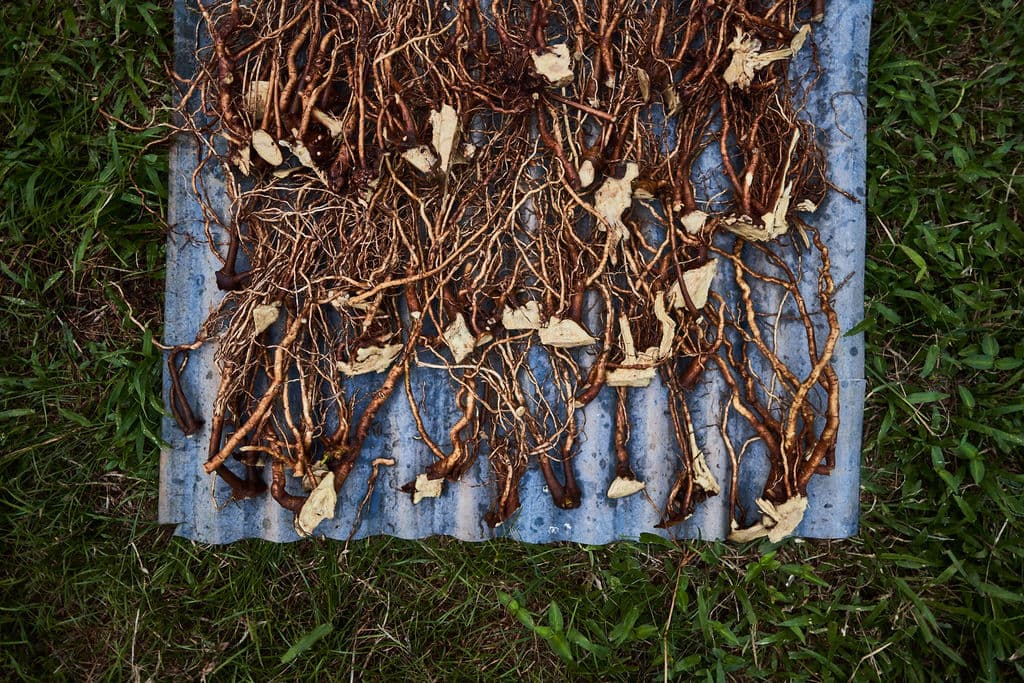
- Mature underground lateral roots and peeled rhizome only.
- Rhizome and basal stump with the outer cork and periderm completely removed.
- No leaves, aerial stems, stem bark or peelings, no adventitious aerial roots, and no above-ground crown material.
Every one of those exclusions removes saleable weight from the batch, and each is a place a cheaper quote can find its margin. When you compare our cost per serve against another supplier’s, the question worth asking is what went into their milligram — see how kava is processed for what each stage controls.
Ready to Source Wholesale Kava
from Kavain?
Experience the Kavain difference. Request a sample today and discover why leading formulators trust us for their kava supply.