Sourcing
The Wholesale Noble Kava Supplier Landscape (2026)
13 min read
Read
The cost stack behind a kilogram of noble kava — and why the cheapest quote is usually the most expensive mistake
"What does kava cost per kilogram?" is the first question most new buyers ask, and it is the hardest one to answer usefully. Quotes for what appears to be the same product routinely differ by a factor of three. That dispersion is not noise, and it is not simply some suppliers charging more than others. It reflects genuine differences in what is inside the bag.
This article breaks down the cost stack behind a kilogram of wholesale noble kava — from what a farmer is paid through to what lands in your warehouse — so you can read a quote and understand what it is telling you about the material.
Key takeaway: Roughly 55–70% of the landed cost of wholesale noble kava is set before the material leaves the Pacific: farmgate price, plant part selection, the 4–5:1 fresh-to-dry weight loss, and noble-only verification. Processing, testing, format conversion, and freight account for the rest. Because the raw material has a hard floor cost, quotes more than about 30% below market are almost never a better deal on the same product — they are a different product, usually involving non-noble cultivars, aerial plant parts, or stem-and-chip filler.
Not all kavalactones are created equal. Cost per milligram treats every milligram as the same thing. It is not. What the milligram was extracted from moves the price far more than the delivery format does, and it is the single biggest reason two quotes for “the same” material can differ by a wide margin.
All Kavain products are based on:
Every one of those exclusions removes saleable weight from the batch, and each is a place a cheaper quote can find its margin. When you compare our cost per serve against another supplier’s, the question worth asking is what went into their milligram — see how kava is processed for what each stage controls.
Every kilogram of noble kava powder that reaches a Western buyer has passed through six cost stages. Understanding the relative weight of each is what lets you judge whether a quote is plausible.
| Stage | What it covers | Approx. share of landed cost |
|---|---|---|
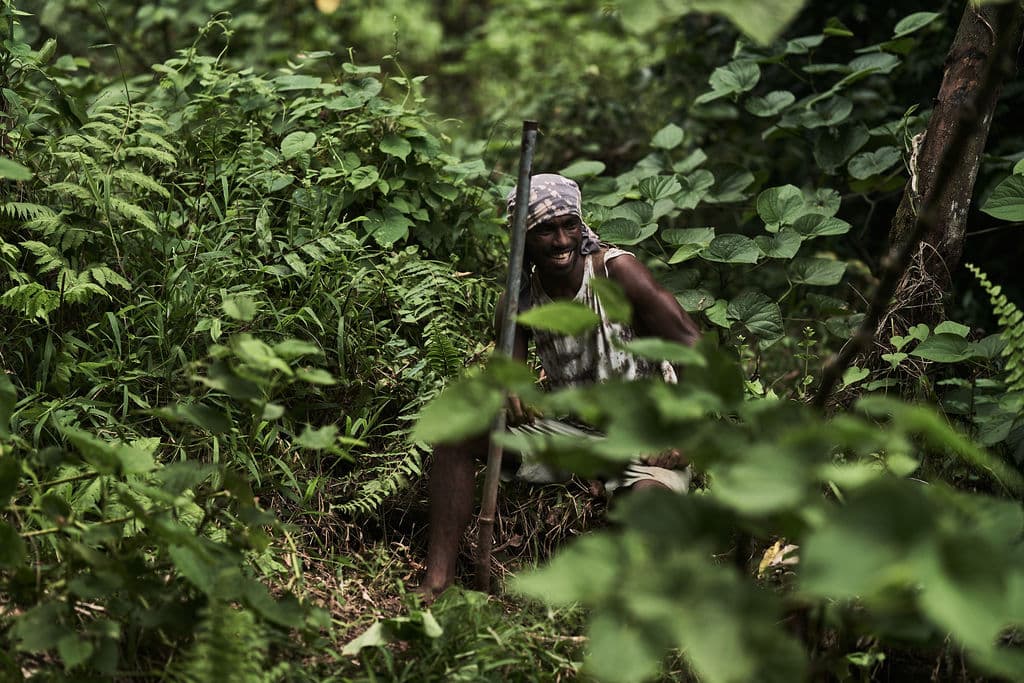
| 1. Farmgate | Payment to the grower for fresh, harvested root | 30–45% |
| 2. Post-harvest | Washing, peeling, splitting, drying, sorting | 10–15% |
| 3. Milling | Grinding, sieving, blending to spec, packing | 5–10% |
| 4. Verification | Chemotype and contaminant testing, export documentation | 5–10% |
| 5. Format conversion | Extraction, emulsification, cGMP manufacturing (extracts only) | 0–45% |
| 6. Logistics | Freight, insurance, duty, customs clearance | 5–15% |
The ranges are wide because format changes the arithmetic completely. For traditional grind root powder, stages 1 and 2 dominate and stage 5 does not exist. For an 80% oleoresin, stage 5 can exceed every other stage combined.
Kava is a slow crop. A plant needs roughly four to five years in the ground before its root mass and kavalactone content justify harvest. Harvesting earlier is possible and it happens when prices spike — but immature root carries lower kavalactone content and a different balance of compounds, which is one reason quality dips in the year following a price surge.
That four-to-five-year lag is the single most important fact about kava pricing, because it means supply cannot respond to demand for half a decade. When Western demand rose sharply, farmers planted more; the market did not feel that new supply until years later. In the meantime, prices ran up. The reverse is also true: a planting boom eventually lands as oversupply and farmgate prices fall, which discourages replanting, which sets up the next shortage. The kava market moves in long cycles, not seasons.
Layered on top is weather. Kava is grown in a cyclone belt. Tropical Cyclone Winston in Fiji (2016), Harold in Vanuatu (2020), and Judy and Kevin in Vanuatu (2023) each destroyed standing kava alongside the rest of the agricultural base. Because the replacement crop takes years, a single severe cyclone season tightens supply well beyond the year it occurs.
For a buyer, the practical implication is that farmgate cost is not a lever a supplier can pull. A supplier quoting materially below the prevailing farmgate-plus-processing floor is not buying the same root more cleverly.
Two things happen between the field and the dry powder, and both are expensive.
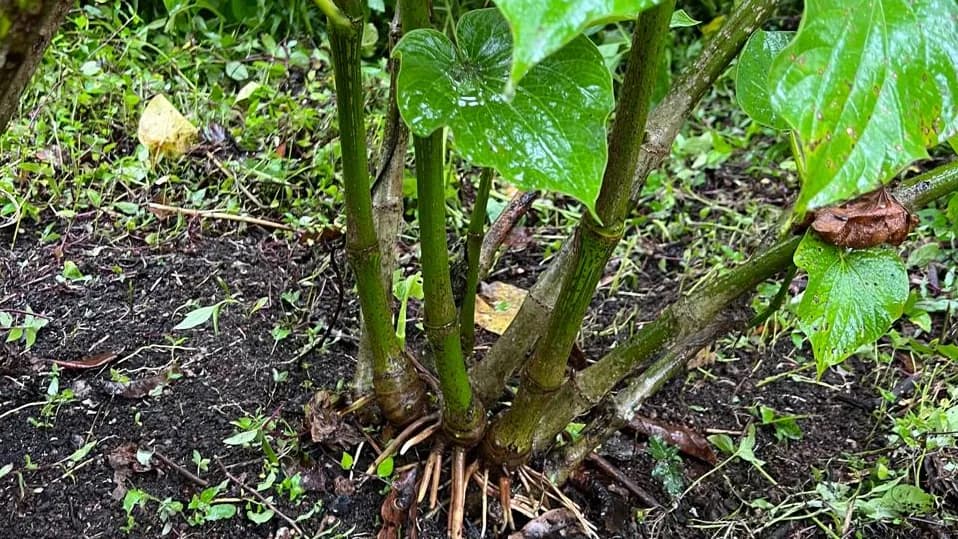
Plant part selection. The kava plant is not uniform. Lateral roots carry the highest kavalactone concentration; the basal stump carries less; the aerial stems and leaves carry a different and undesirable compound profile and are excluded from quality material entirely. In Fijian terminology, lateral-root material is waka and stump material is lewena, and they command different prices for good reason — waka can carry meaningfully higher kavalactone content than lewena from the same plant.
This is the most common place for a cheap quote to be hiding something. Blending in stump, stem, or chip material lowers the input cost substantially while still producing something that looks like kava powder and tests as kava. It will assay lower on kavalactones, and if aerial parts are involved it carries the safety concerns that shaped the entire regulatory history of this category. A supplier should be able to state plant-part specification in writing.
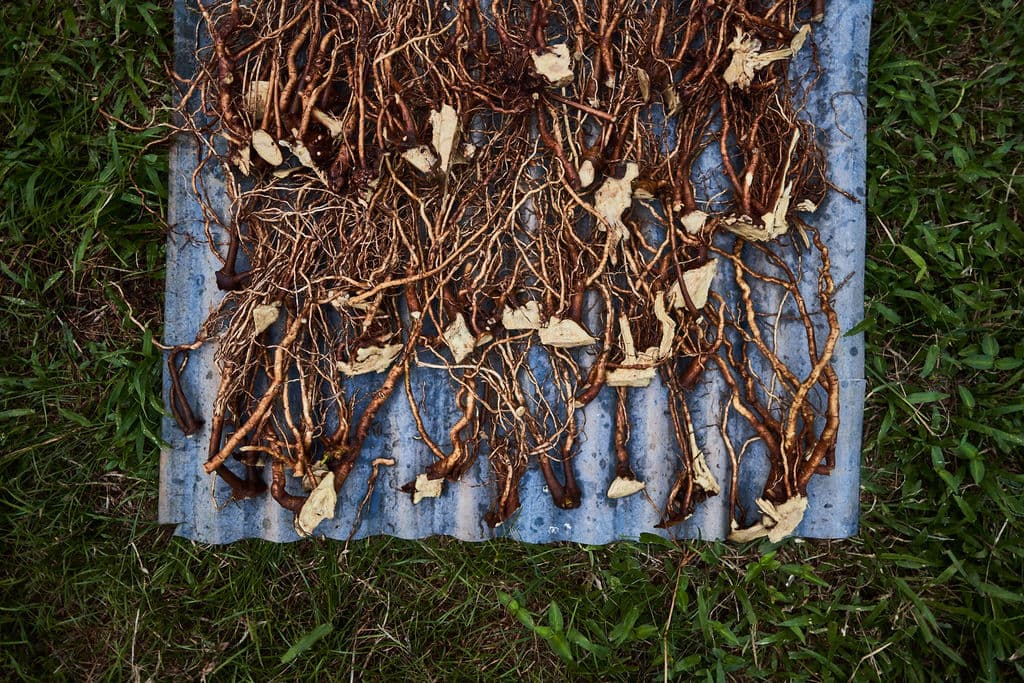
Drying loss. Fresh kava root is mostly water. Drying it to a stable moisture content removes roughly 75–80% of its mass — a ratio in the region of four to five kilograms of fresh root for every kilogram of dry material. Every cost in stage 1 is therefore multiplied by four to five before you have a single kilogram of sellable powder. Buyers who compare a farmgate price they have heard quoted for fresh root against a wholesale price for dried powder and conclude the margin is enormous have usually missed this step.
Drying method also matters to cost and quality. Sun drying is cheap but weather-dependent and raises microbial and mould risk if rain interrupts the cycle. Mechanical or controlled drying costs more per kilogram and produces more consistent, lower-risk material. That difference is real and it shows up in the price.
A per-batch Certificate of Analysis with genuine scope costs money — and the scope varies enormously between suppliers who both use the phrase "lab tested".
A full panel covers HPLC kavalactone profiling reporting all six kavalactones individually, heavy metals against USP <232> limits, microbial screening, pesticide residues, and — for any extract format — residual solvents per USP <467>. Run properly through an ISO/IEC 17025-accredited laboratory, that is a per-batch cost in the hundreds of dollars, and it recurs for every batch rather than being amortised across a year.
Suppliers who skip most of that panel, or who reuse a single historical certificate across many batches, have a real cost advantage. It is not one you want to buy. For what a complete panel should contain, see the kava supplier vetting checklist.
Noble-only verification carries its own cost. Both Fiji and Vanuatu now restrict kava export to noble cultivars by law, but legal restriction and verified compliance are different things. Chemotype testing on intake, followed by flavokavain analysis where the profile warrants it, is what turns a claim into evidence — and it costs money per lot. See how to read a kava chemotype for what those digits mean.
Format conversion is where price differences become dramatic, and where buyers most often misread the numbers.
Producing a 70–80% kavalactone oleoresin requires many kilograms of dried root as input, supercritical CO2 or comparable extraction equipment, cGMP-compliant manufacturing, and residual-solvent verification on the output. Nano-emulsified formats add a further manufacturing stage: emulsification with food-grade phosphatides and lipid carriers, stabilisation, and either spray drying onto a carrier matrix or aqueous stabilisation.
So an oleoresin priced at roughly fourteen times traditional grind per kilogram looks expensive. Per milligram of kavalactones it is not — an 80% oleoresin carries around ten to thirteen times the active material of a 6–8% root powder, so most of that multiple is simply the concentration, not a margin premium.
This is exactly why comparing formats on price per kilogram produces the wrong answer. The comparison that matters is cost per milligram of kavalactones, translated into cost per serve. Our cost per serve calculator does that arithmetic against live wholesale pricing for every format.
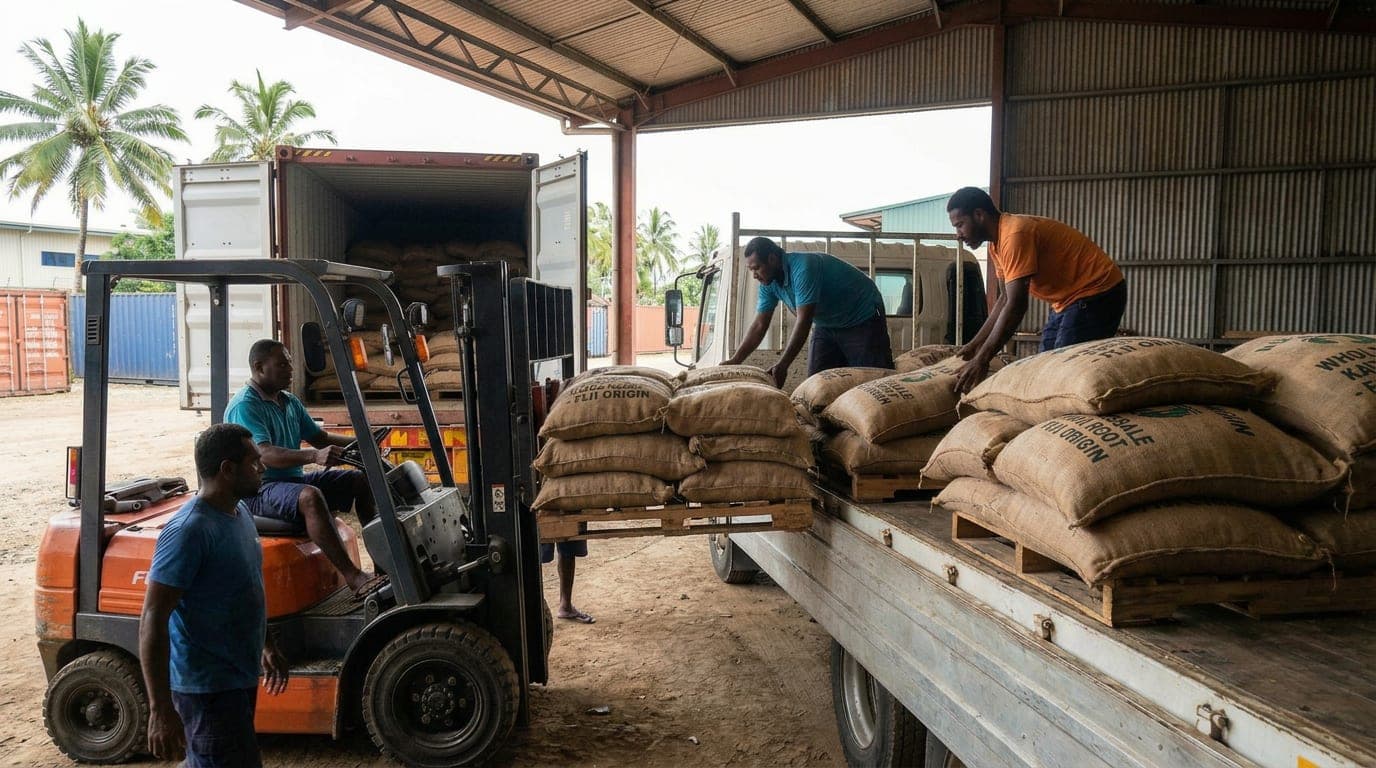
Pacific Island freight is not cheap and it is not fast. Sea freight from Fiji or Vanuatu to North America or Europe runs four to six weeks; air freight compresses that to days at several times the cost per kilogram.
The practical consequence is that quotes are not comparable unless you know the incoterms. A quote that looks 15% cheaper ex-works can land more expensive than a delivered-duty-paid quote once freight, insurance, customs brokerage, and duty are added. Ask for the basis before comparing.
Freight economics also reward concentration. Shipping a kilogram of 80% oleoresin moves as much active material as ten to thirteen kilograms of root powder. For buyers importing at volume, that difference in freight cost per milligram of kavalactones is not a rounding error.
Wholesale kava pricing tiers with volume, but not uniformly across formats.
For root powder, the cost floor is agricultural and the scope for volume discount is genuinely limited — a supplier cannot discount past what they paid growers. The tiering that exists mostly reflects processing, packing, and freight efficiencies.
For extracts and nano formats, more of the cost sits in manufacturing overhead that amortises across batch size, so volume discounts can be steeper. A production run at scale absorbs the same setup, cleaning, and verification cost as a small one.
This has a counterintuitive implication: the format ranking on cost per serve at 1 kg is not necessarily the ranking at 100 kg. Buyers modelling a scale-up should re-run the comparison against tiered pricing rather than assuming the entry-level ordering holds.
One warning sign worth naming: a supplier offering flat pricing at any volume is unusual. It generally means either that the quoted price already includes a large volume margin, or that the supplier is a repackager buying at retail-adjacent rates themselves.
Raw noble kava has a floor cost, set by the four-to-five-year growing cycle, the farmgate price, and the fresh-to-dry conversion. That floor moves with the cycle, but at any given moment it is real and every legitimate supplier is working above it.
When a quote comes in more than about 30% below the prevailing market, the difference is almost never operational efficiency. In practice it resolves to one of a short list of explanations:
None of these are visible in a milled powder without testing, which is the entire point. The defence is not price scepticism alone — it is requiring a per-batch Certificate of Analysis with real scope, and reading the kavalactone assay on it.
Five questions turn an opaque number into a comparable one:
With those five answers you can convert any quote to a cost per milligram of kavalactones and compare suppliers on the same basis. Without them you are comparing bag weights.
Kava pricing looks irrational from the outside and is fairly disciplined once the cost stack is visible. Most of the price is agricultural and set years in advance by planting decisions and weather. Most of the dispersion between quotes is explained by what is actually in the bag — plant part, cultivar, maturity, and whether anyone verified it.
Good kava cannot be cheap in absolute terms, because the crop takes half a decade and loses four-fifths of its weight on the way to a bag. But it can be cheap per serve, which is the number that governs a business. Those are different questions, and conflating them is the most common costing error we see from buyers new to the category.
To work the second question properly, use the cost per serve calculator. To evaluate whether a supplier's price is backed by real verification, work through the supplier vetting checklist.
Continue exploring kava industry insights
Experience the Kavain difference. Request a sample today and discover why leading formulators trust us for their kava supply.